
6 Edenton Tea Party Facts Most New Residents Get Wrong

In this post
- 1. Was any tea actually dumped in Edenton?
- 2. Who actually organized it?
- 3. What exactly did the women promise?
- 4. Did 51 women really crowd into Elizabeth King’s parlor?
- 5. How did England answer back?
- 6. Why did the story nearly disappear, and where can you still see it today?
- What that means when you are looking at Edenton
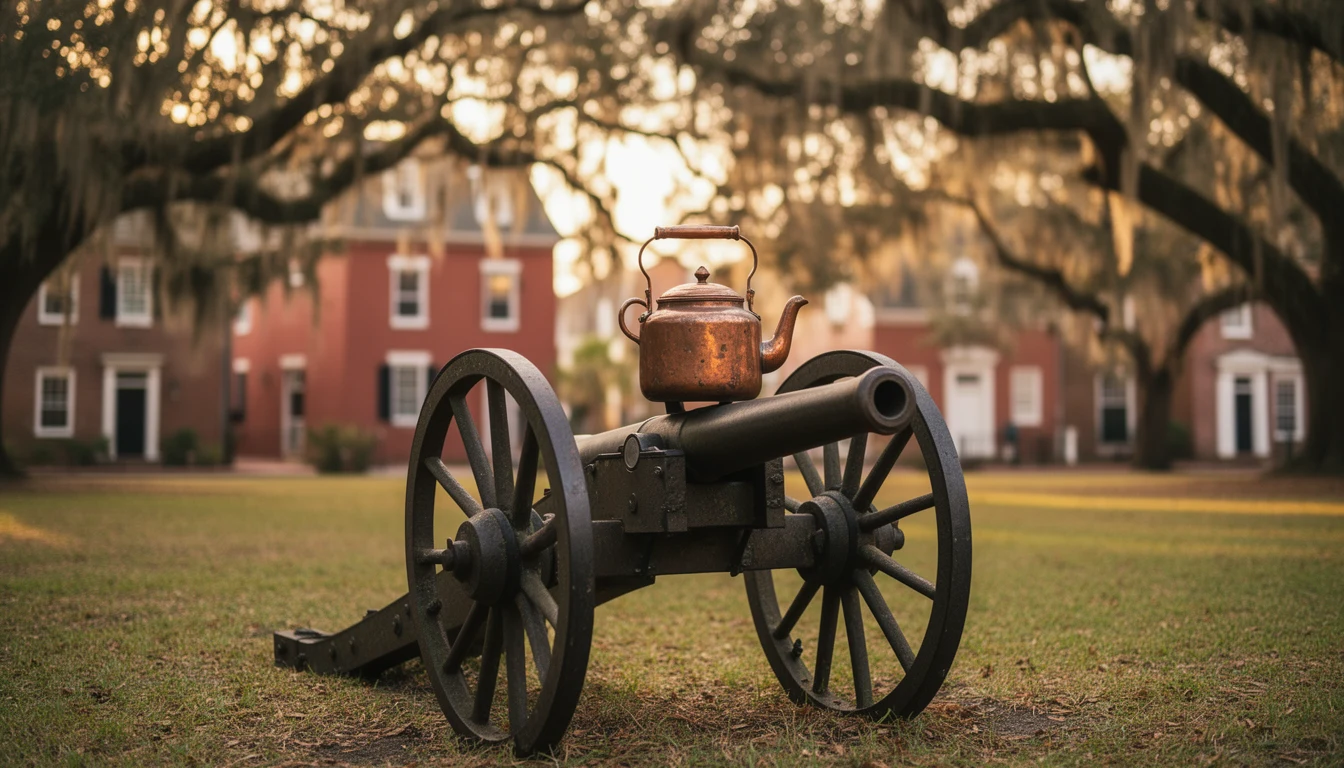
Stand at the edge of the courthouse green in Edenton, where the old brick gives way to Colonial Avenue, and you will find a copper teapot balanced on top of a Revolutionary War cannon. The pot has gone green with salt air, the iron is dark with rain, and out on Edenton Bay the halyards are clanking against masts you cannot see from here but can hear clearly. That monument marks the Edenton Tea Party. If you are new to town, or shopping for a house here, you probably know the one-line version of the story. Most of the details people repeat are somewhere between half right and invented.
Here are six facts worth knowing before you tell it yourself.
1. Was any tea actually dumped in Edenton?
No. Nothing went into the water. Boston gets the harbor raid, December 1773, when chests of tea went overboard in protest of the Tea Act. Edenton’s protest came on October 25, 1774, and it was paper and ink: 51 women drew up a resolution to stop buying British tea and cloth, signed it, and mailed it to England. There is no record of a single tea chest being opened on the Edenton waterfront.
The name stuck anyway, which is why the mix-up keeps getting passed around.
2. Who actually organized it?
Penelope Barker, whose husband Thomas Barker was treasurer of the Province of North Carolina. She played the key role in organizing the resolution, and the women who signed did not hide: NC DNCR notes they put their real names on the document, an act of nerve in an era when women’s politics were supposed to be invisible.
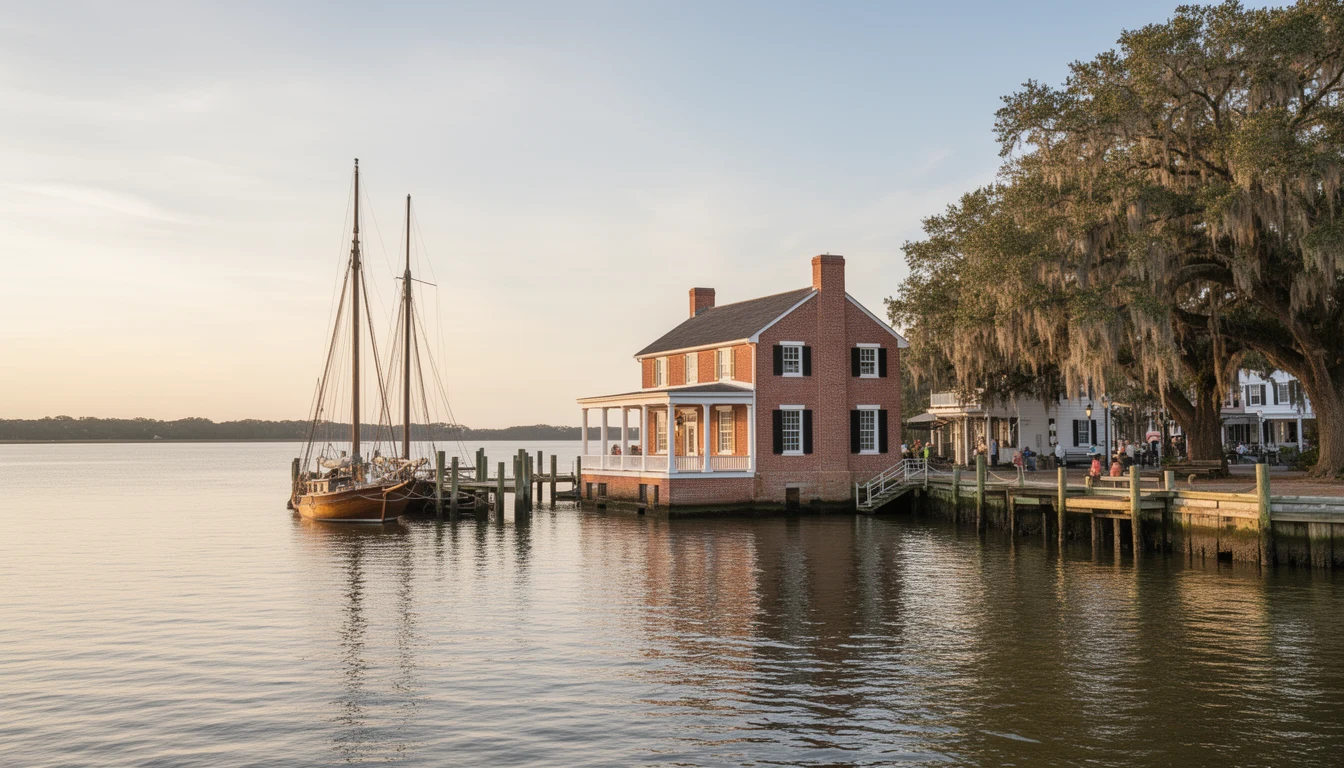
Her house, built in 1782 at 505 South Broad Street, is now Edenton’s Welcome Center and the home of the Edenton Historical Commission. The front porch is one of the best free seats in town for watching the bay.
3. What exactly did the women promise?
More than giving up tea. The resolution committed the signers to stop buying English tea and English cloth, and to support the American cause against taxation without representation.
Tea gets top billing because tea was the daily social ritual of the era; a colonial household that swore off it felt the sacrifice every afternoon. Cloth was the sharper economic jab at British merchants, since nearly every family in the colonies bought English fabric. In their own words, the signers were “determined to give memorable proof of their patriotism.”
4. Did 51 women really crowd into Elizabeth King’s parlor?
Almost certainly not. This is the detail in most retellings, and NCpedia flags it as one of the primary errors in the story.
The tradition says the women gathered at the home of Elizabeth King, a prominent member of the Edenton community. NCpedia points out that the King house was too small for an assembly of 51, and that the wording of the resolution reads like an agreement circulated for signatures, not minutes from a meeting. The date and the document are real. The drawing-room scene was likely stitched together decades later.
5. How did England answer back?
London did not ignore the women. It laughed at them, in print.
The Morning Chronicle and London Advertiser ran an account on January 16, 1775, with a drawing that showed them in an unflattering light. Two months later, the London print shop of R. Sayer and J. Bennett sold a mezzotint by Philip Dawe titled “A Society of Patriotic Ladies, at Edenton in North Carolina,” picturing the signers as neglectful of their homes and families. Arthur Iredell, writing from London to his brother James, the future U.S. Supreme Court justice who practiced law in Edenton, reported that England did not take the protest seriously because it was led by women: “the only security on our side is the probability that there are but few places in America which possess so much female artillery as Edenton.”
In the colonies the reaction ran the other way. The women were praised. A copy of the Dawe cartoon hangs inside the Barker House Welcome Center today, and it is worth the stop on its own.
6. Why did the story nearly disappear, and where can you still see it today?
The event went unrecorded in North Carolina at the time. NCpedia explains that the story stayed largely unknown until 1827, when a North Carolina-born naval officer bought a copy of the British cartoon in a shop overseas. When he brought it home, residents tried to piece together what had actually happened in 1774, and some of the details added then are still repeated now.
The town kept the memory visible anyway. The copper teapot on the cannon at the green’s edge commemorates the Tea Party; the pot was cast in 1906 by Frank Baldwin of Watertown, Connecticut, and the local chapter of the Daughters of the American Revolution carries the Tea Party’s name. Walk a block south and the Barker House anchors the waterfront end of the same story.
What that means when you are looking at Edenton
The Tea Party is a fair test of what this town is like to live in. The legend is tidy and dramatic, and the record is quieter and more complicated. Edenton does not perform its history; it just leaves it on the street grid and lets you live with it. That is the honest trade-off of buying here: you get a story you can walk in five minutes, but you also get the work of telling it accurately when friends visit.
On a house-hunting trip, make the Barker House Welcome Center your first stop. Grab a map, look at the cartoon, and then walk the green to the teapot before you look at a single listing. You will understand the neighborhood better than most of the people who already live here.
Keep reading
New Edenton Boat Builder Opens: What It Means for Buyers
The Whiskey Project opened a 60,000 square foot boat plant in Edenton on Oct. 20. What 200 promised jobs mean for Chowan County buyers and resale.
Retirees Shortlist Edenton: 8 Reasons, 2 Trade-Offs
Eight reasons retirees keep shortlisting Edenton, NC, and the two trade-offs that send some back. Taxes, walkability, water, and the honest math.
Chowan's Joe Hollowell Joins State Coastal Commission
A Chowan County leader joins the state board that writes coastal development rules. What it means for Edenton waterfront buyers and sellers.